
Adult ADHD: Common Signs That Often Go Unnoticed
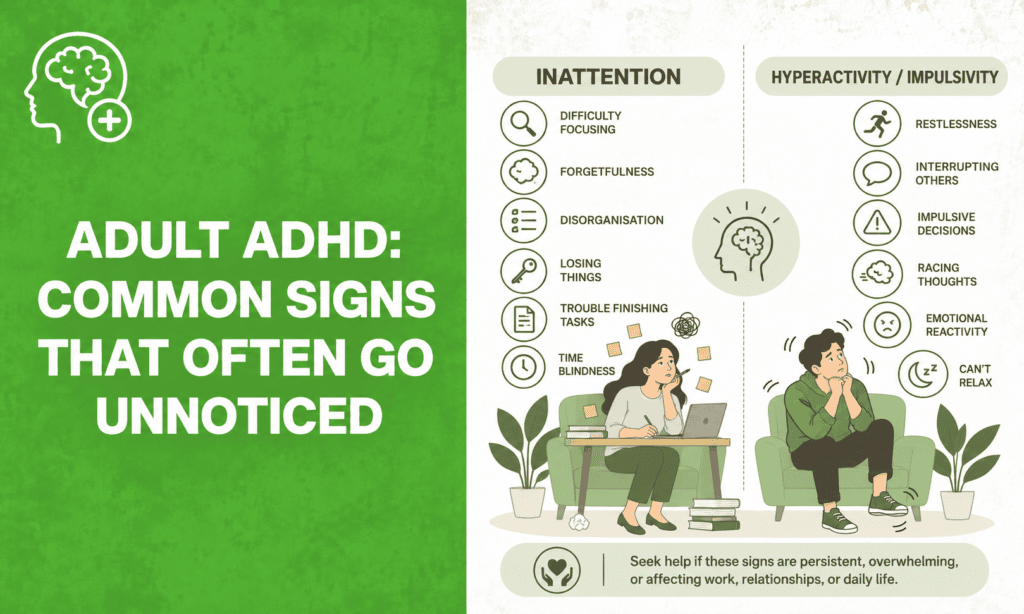
Attention-Deficit/Hyperactivity Disorder, commonly known as ADHD, is often associated with children who are highly active, impulsive or unable to sit still. However, ADHD can continue into adulthood, and in many people, the signs may look very different from the stereotypical image of ADHD.
Some adults live for years with difficulties involving concentration, organisation, procrastination, forgetfulness or emotional regulation without realising that ADHD could be contributing to these patterns.
Understanding the common signs of adult ADHD can help you recognise when everyday struggles may be worth discussing with a qualified mental health professional.
What Is Adult ADHD?
Adult ADHD is a neurodevelopmental condition that can affect attention, impulse control, activity levels, organisation and executive functioning.
ADHD usually begins during childhood, although some people may not be diagnosed until adulthood. This can happen when symptoms were less obvious during childhood, were misunderstood, or became more noticeable only when adult responsibilities increased.
Work deadlines, finances, household management, relationships, parenting and multiple responsibilities can place greater demands on planning and organisation. For some adults, these demands make previously manageable ADHD-related difficulties much more noticeable.
Why Does Adult ADHD Often Go Unnoticed?
Adult ADHD can be overlooked for several reasons.
- Symptoms may be mistaken for laziness or lack of discipline
- Some people develop strong coping strategies that hide their difficulties
- Hyperactivity may become less obvious with age
- Symptoms may mainly involve inattention rather than visible restlessness
- Difficulties may be attributed to stress, anxiety or burnout
- People may perform well academically or professionally despite struggling internally
- Women and adults with predominantly inattentive symptoms may be less likely to fit common ADHD stereotypes
As a result, some adults may spend years wondering why everyday tasks seem to require considerably more effort for them than for others.
Common Signs of ADHD in Adults
ADHD does not look exactly the same in everyone. Symptoms can differ depending on the individual, the environment and the type of demands they face.
Here are some adult ADHD signs that often go unnoticed.
1. Difficulty Staying Focused
One of the most recognised symptoms of ADHD is difficulty sustaining attention, particularly during tasks that feel repetitive, routine or uninteresting.
An adult with ADHD may:
- Lose focus during meetings
- Read the same paragraph repeatedly
- Become distracted during conversations
- Switch between tasks without finishing them
- Have difficulty concentrating when there are distractions nearby
This does not necessarily mean that a person with ADHD cannot focus at all. In fact, some adults can become extremely absorbed in activities that strongly interest them.
2. Frequently Starting Tasks but Not Finishing Them
Starting a new project may feel exciting, but maintaining attention until completion can be difficult.
You may notice a pattern of:
- Starting multiple projects at the same time
- Losing interest midway through a task
- Leaving household chores half completed
- Moving to another task before finishing the first one
- Having many unfinished personal or professional projects
This pattern can sometimes be misunderstood as a lack of commitment when it may actually relate to difficulties with sustained attention and executive functioning.
3. Chronic Procrastination
Many adults with ADHD repeatedly delay tasks, even when they know those tasks are important.
Procrastination may be particularly common when a task feels:
- Boring
- Complicated
- Repetitive
- Overwhelming
- Unclear
- Far away from its deadline
Some people find that they are able to complete tasks only when the deadline becomes urgent and the pressure creates enough stimulation to maintain their attention.
4. Constantly Losing Everyday Items
Misplacing things occasionally is normal. However, adults with ADHD may find that losing everyday objects becomes a frequent and frustrating pattern.
Commonly misplaced items may include:
- Keys
- Wallets
- Phones
- Glasses
- Office documents
- Chargers
- Important paperwork
The person may know they had the item only moments earlier but struggle to remember where they placed it.
5. Forgetting Appointments and Important Tasks
Forgetfulness can be another common but overlooked sign of adult ADHD.
This might include:
- Missing appointments
- Forgetting meetings
- Forgetting to pay bills
- Leaving messages unanswered
- Forgetting errands
- Walking into a room and forgetting why
- Forgetting what someone asked moments earlier
This can sometimes create problems at work or in relationships, particularly when others interpret forgetfulness as carelessness or lack of interest.
6. Difficulty Managing Time
Adults with ADHD may have difficulty accurately estimating how long something will take.
This can lead to:
- Frequently being late
- Underestimating travel time
- Starting work too close to a deadline
- Feeling that time disappears quickly
- Spending much longer than expected on certain tasks
Some people informally describe this as “time blindness,” although this is not itself a diagnostic term.
7. Difficulty Organising Everyday Life
Organisation can require considerable mental effort for adults with ADHD.
You may struggle with:
- Keeping your workspace organised
- Managing emails
- Creating realistic schedules
- Prioritising tasks
- Keeping track of paperwork
- Managing multiple deadlines
- Planning household responsibilities
Sometimes the issue is not knowing what needs to be done, but deciding where to begin and maintaining a system consistently.
8. Feeling Overwhelmed by Simple Tasks
A task that appears simple from the outside can involve many smaller steps.
For example, “clean the house” may involve deciding which room to start with, gathering supplies, sorting objects, prioritising tasks and staying focused long enough to complete them.
Adults with ADHD may feel overwhelmed when they need to organise multiple small steps at once.
This can lead to avoidance, frustration or procrastination.
9. Difficulty Prioritising Tasks
When several things need attention, deciding which task should come first can be challenging.
A person may:
- Spend time on less important tasks while urgent work is delayed
- Focus on what feels interesting rather than what is important
- Jump between priorities
- Become stuck because everything feels equally urgent
This difficulty can become particularly noticeable in demanding work environments.
10. Hyperfocus on Interesting Activities
It may seem contradictory, but some adults with ADHD experience periods of intense focus on activities that strongly interest them.
During these periods, a person may become so absorbed that they:
- Lose track of time
- Forget meals
- Ignore messages
- Delay other responsibilities
- Continue working on an activity for hours
ADHD is therefore not simply an inability to focus. It often involves difficulty regulating where attention is directed and how easily it can be shifted.
11. Restlessness That Is Not Always Obvious
Hyperactivity in adults may not look like constant running or physical activity.
Instead, it can appear as:
- Constantly tapping your foot
- Fidgeting
- Frequently changing sitting positions
- Feeling uncomfortable sitting still for long periods
- Needing to keep busy
- Feeling internally restless
- Having difficulty relaxing
Some adults describe feeling as though their mind is constantly active even when their body is still.
12. A Mind That Feels Constantly Busy
Adults with ADHD may describe their thoughts as moving rapidly from one subject to another.
You may experience:
- Several thoughts competing for attention
- Difficulty mentally switching off
- Constant internal conversations
- Frequent new ideas
- Difficulty organising thoughts before speaking
However, racing thoughts can also occur with anxiety and other mental health conditions, so this symptom alone does not indicate ADHD.
13. Interrupting Others Without Intending To
Impulsivity may affect conversations.
An adult with ADHD may:
- Finish another person’s sentences
- Interrupt because they are afraid they will forget their thought
- Answer before a question is completed
- Speak before fully thinking through what they want to say
These behaviours can sometimes be misunderstood as impatience or disrespect, even when that is not the person’s intention.
14. Impulsive Decisions
ADHD can sometimes make it difficult to pause before taking action.
Impulsivity may appear as:
- Impulse purchases
- Making decisions quickly
- Changing plans suddenly
- Speaking without considering the consequences
- Taking unnecessary risks
The severity of impulsivity varies considerably between individuals.
15. Emotional Overwhelm
Some adults with ADHD report difficulty regulating strong emotions.
This might include:
- Becoming frustrated quickly
- Feeling easily overwhelmed
- Strong emotional reactions to small problems
- Difficulty calming down after becoming upset
- Feeling emotionally exhausted after stressful situations
Emotional regulation difficulties can occur for many different reasons and are not specific to ADHD, but they may be part of the overall pattern for some adults.
16. Sensitivity to Criticism or Perceived Failure
Adults who have struggled with undiagnosed ADHD may have experienced years of criticism related to forgetfulness, lateness, unfinished work or inconsistent performance.
Over time, this may contribute to:
- Low confidence
- Fear of making mistakes
- Feeling unusually affected by criticism
- Perfectionism
- Avoiding situations where failure feels possible
These experiences are not diagnostic symptoms of ADHD, but they can develop alongside long-term ADHD-related challenges.
17. Inconsistent Performance
One commonly overlooked pattern is the ability to perform extremely well in some situations but struggle significantly in others.
For example, someone may:
- Complete a difficult project successfully under pressure
- Struggle with routine administrative tasks
- Perform exceptionally well when highly interested
- Find simple repetitive tasks unusually difficult
This inconsistency can be confusing both for the person and for those around them.
18. Difficulty Following Conversations
You may appear to be listening while your attention has drifted elsewhere.
Signs may include:
- Realising you missed part of a conversation
- Asking someone to repeat information
- Forgetting instructions shortly after receiving them
- Becoming distracted by sounds or activity nearby
This can sometimes create misunderstandings in personal and professional relationships.
19. Difficulty Maintaining Routines
Creating a routine may be easier than consistently following it.
An adult may repeatedly:
- Start using a planner and stop after a few days
- Begin a new exercise routine and lose momentum
- Create detailed productivity systems but struggle to maintain them
- Frequently change organisational methods
The difficulty may lie in consistency rather than motivation alone.
20. Feeling Mentally Exhausted From Trying to Stay Organised
Some adults learn to compensate for attention or organisational difficulties by creating reminders, lists, alarms, calendars and detailed routines.
These strategies can be effective, but maintaining them may require significant effort.
As a result, someone may appear organised externally while feeling mentally exhausted internally.
Adult ADHD in Women: Why Can It Be Missed?
ADHD can sometimes be overlooked in women, particularly when symptoms are predominantly inattentive rather than highly visible or disruptive.
Some women may experience:
- Difficulty concentrating
- Chronic disorganisation
- Forgetfulness
- Procrastination
- Feeling mentally overwhelmed
- Difficulty managing multiple responsibilities
- Low confidence resulting from years of struggling with everyday tasks
Because these difficulties may not match the traditional stereotype of hyperactive ADHD, they can sometimes be attributed to stress, personality or lack of organisation.
Can You Have ADHD Without Being Hyperactive?
Yes.
Not every person with ADHD displays obvious hyperactivity.
Some adults primarily experience symptoms involving:
- Attention difficulties
- Forgetfulness
- Disorganisation
- Distractibility
- Difficulty completing tasks
Others may experience a combination of inattentive and hyperactive-impulsive symptoms.
Is Adult ADHD the Same as Being Distracted?
No. Everyone becomes distracted, forgetful or disorganised occasionally.
ADHD involves a persistent pattern of symptoms that begins during development and causes meaningful difficulties in important areas of life.
A professional assessment considers factors such as:
- How long the symptoms have been present
- Whether similar difficulties existed during childhood
- Whether symptoms occur in more than one setting
- How strongly symptoms affect work, education, relationships or daily responsibilities
- Whether another condition could better explain the symptoms
ADHD vs Anxiety: How Can You Tell the Difference?
ADHD and anxiety can sometimes look similar.
Both may involve:
- Difficulty concentrating
- Restlessness
- Sleep difficulties
- Forgetfulness
- Feeling overwhelmed
However, the reasons behind these symptoms may be different.
For example, someone with anxiety may have difficulty concentrating because their attention is occupied by worry. Someone with ADHD may become distracted even when they are not feeling particularly anxious.
ADHD and anxiety can also occur together, which is why a comprehensive assessment is important.
ADHD vs Stress and Burnout
Stress and burnout can also cause symptoms that resemble ADHD, including poor concentration, forgetfulness, irritability and difficulty completing tasks.
One important difference is that ADHD-related patterns generally have a longer developmental history rather than beginning only after a stressful period.
If concentration difficulties have appeared recently, a clinician may consider factors such as:
- Stress
- Burnout
- Anxiety
- Depression
- Sleep difficulties
- Medical conditions
- Medication or substance-related factors
Can ADHD Suddenly Start in Adulthood?
ADHD is considered a neurodevelopmental condition, which means symptoms begin during childhood or adolescence, even if the condition is not recognised until much later.
However, people may become aware of their symptoms only during adulthood when their responsibilities increase.
For example, someone who managed well within the structured environment of school or university may struggle once they have to independently manage work, finances, relationships and household responsibilities.
How Is Adult ADHD Diagnosed?
There is no single blood test or scan that can diagnose ADHD.
An ADHD assessment usually involves a detailed evaluation by an appropriately qualified mental health professional.
The assessment may explore:
- Current symptoms
- Childhood behaviour and developmental history
- Academic history
- Work-related difficulties
- Relationships and daily functioning
- Medical and mental health history
- Standardised ADHD questionnaires or rating scales
The clinician will also consider whether symptoms may be better explained by another mental health or medical condition.
Can an Online ADHD Test Diagnose ADHD?
No. Online questionnaires and ADHD screening tools may help identify whether certain symptoms are present, but they cannot provide a clinical diagnosis on their own.
A high score on an ADHD screening questionnaire does not automatically mean that you have ADHD.
Similarly, a low score does not necessarily rule out every possibility.
If your symptoms are affecting your daily life, a professional assessment can provide a more complete understanding.
When Should You Consider an ADHD Assessment?
You may want to speak with a qualified professional if you frequently experience several of the following difficulties:
- Persistent concentration problems
- Difficulty organising your responsibilities
- Repeatedly missing important deadlines
- Frequent forgetfulness
- Significant procrastination
- Difficulty completing tasks
- Constant restlessness
- Impulsive behaviour
- Difficulty managing work or academic responsibilities
- Relationship difficulties linked to forgetfulness or impulsivity
- A long-standing feeling that everyday organisation requires excessive effort
An assessment can help determine whether these experiences are related to ADHD or whether another condition may be contributing.
How Is Adult ADHD Managed?
Management varies depending on the person’s symptoms, circumstances and any other mental health concerns.
A treatment or support plan may include a combination of approaches.
Psychological Therapy
Therapy can help adults with ADHD understand their patterns and develop practical strategies for managing everyday challenges.
Areas addressed in therapy may include:
- Time management
- Procrastination
- Organisation
- Emotional regulation
- Managing stress
- Developing realistic routines
- Improving communication
Behavioural and Organisational Strategies
Practical strategies may include:
- Breaking large tasks into smaller steps
- Using calendars and reminders
- Creating visible to-do lists
- Reducing distractions in the work environment
- Setting shorter deadlines
- Using structured routines
- Keeping frequently used items in consistent locations
Medication
For some adults, medication may form part of ADHD treatment.
Medication should only be prescribed and monitored by an appropriately qualified medical professional after a proper clinical assessment.
Can Adults With ADHD Be Successful?
Yes. Having ADHD does not determine a person’s intelligence, ability or potential.
Many adults with ADHD perform successfully in demanding careers, relationships and other areas of life.
The main challenge is often understanding how their attention and executive functioning work and developing strategies that fit their individual needs.
Receiving an appropriate diagnosis can sometimes help people make sense of patterns they may have misunderstood for many years.
Adult ADHD: Key Takeaway
Adult ADHD does not always look like obvious hyperactivity.
It may appear as chronic procrastination, forgetfulness, disorganisation, difficulty concentrating, inconsistent performance, impulsivity, emotional overwhelm or a constant struggle to manage everyday responsibilities.
Having one or two of these experiences does not automatically mean that you have ADHD. Many of these symptoms can also occur because of stress, anxiety, depression, sleep problems or other conditions.
However, if these patterns have been present for many years and are affecting your work, relationships or daily functioning, an ADHD assessment may help you understand what is contributing to the difficulty.
Frequently Asked Questions About Adult ADHD
1. What are the most common signs of ADHD in adults?
Common signs may include difficulty concentrating, frequent distraction, procrastination, disorganisation, forgetfulness, impulsivity, restlessness and difficulty completing tasks.
2. Can someone have ADHD and still be successful at work?
Yes. Many adults with ADHD are successful professionally. Some develop effective coping strategies or perform particularly well in environments that match their strengths and interests.
3. Can you have mild ADHD?
ADHD symptoms vary in severity. Some people experience relatively mild impairment, while others have symptoms that significantly affect multiple areas of daily life.
4. Can ADHD be diagnosed in your 30s or 40s?
Yes. Some people are diagnosed much later in adulthood, particularly when symptoms were overlooked during childhood.
5. Does ADHD cause overthinking?
People with ADHD may experience busy or rapidly shifting thoughts, but overthinking can also occur with anxiety and other conditions. It is not specific to ADHD.
6. Is forgetfulness always a sign of ADHD?
No. Forgetfulness can occur because of stress, poor sleep, anxiety, depression, medical conditions and many other factors. ADHD is diagnosed based on a broader and persistent pattern of symptoms.
7. Is ADHD more noticeable when adults are stressed?
Symptoms may become more difficult to manage during periods of increased stress, poor sleep or greater responsibility.
8. Can therapy help adults with ADHD?
Yes. Therapy can help adults develop strategies for organisation, time management, procrastination, emotional regulation and other difficulties associated with ADHD.
9. Do I need an ADHD assessment if I relate to these symptoms?
Relating to a few symptoms does not necessarily mean you need a diagnosis. However, if these patterns are persistent, have been present for many years and are affecting important areas of your life, a professional assessment may be useful.
Get Professional Support for Adult ADHD
If difficulties with concentration, organisation, procrastination, forgetfulness or impulsivity are affecting your daily life, a professional assessment can help you understand what may be contributing to these patterns.
At Inspiron Psychological Well-Being Centre, our mental health professionals provide psychological assessments and support for adults experiencing attention, emotional or behavioural concerns.
Book an assessment or consultation to understand your symptoms more clearly and explore appropriate next steps.