
Therapy vs Counselling: What’s the Difference?
When people decide to seek professional support for their mental health, one of the first questions they often have is:
Should I look for therapy or counselling?
The two terms are frequently used interchangeably, which can make the difference difficult to understand.
Both therapy and counselling involve speaking with a trained mental health professional in a confidential and supportive environment. Both can help people understand emotions, manage stress, improve relationships, cope with difficult experiences, and develop healthier ways of responding to challenges.
However, depending on the professional, setting, and type of concern, counselling and therapy may differ in their focus, depth, duration, and goals.
In this guide, we will explain the difference between therapy and counselling, when each may be helpful, what happens during sessions, and how to decide which type of support may be right for you.
What Is Counselling?
Counselling generally refers to professional support that helps people work through specific emotional, situational, or life-related concerns.
It may focus on a particular challenge that is currently affecting your well-being.
For example, someone may seek counselling because they are experiencing:
- Work-related stress
- Relationship difficulties
- Grief or loss
- Academic pressure
- Family conflict
- Life transitions
- Decision-making difficulties
- Adjustment to a major change
Counselling often focuses on understanding the current concern, providing emotional support, improving coping skills, and helping the individual move towards practical solutions.
It may be short-term, although the duration depends on the person’s needs and the type of support being provided.
What Is Therapy?
Therapy, or psychotherapy, is a broader term for structured psychological treatment designed to help people understand and change patterns in their thoughts, emotions, behaviours, and relationships.
Therapy may address current problems, but it may also explore deeper or long-standing patterns that contribute to emotional difficulties.
People may seek therapy for concerns such as:
- Anxiety
- Overthinking
- Persistent low mood
- Trauma-related concerns
- Relationship patterns
- Low self-esteem
- Emotional regulation difficulties
- Repeated behavioural patterns
- Chronic stress
- Difficulty setting boundaries
- Long-standing emotional difficulties
Therapy may involve exploring past experiences, current thought patterns, emotional responses, relationships, beliefs, and coping behaviours.
The goal is often not only to manage immediate symptoms but also to understand the underlying patterns that may be contributing to them.
Therapy vs Counselling: What Is the Main Difference?
The distinction is not always strict.
In many settings, the terms therapy and counselling are used interchangeably.
However, a simple way to understand the difference is:
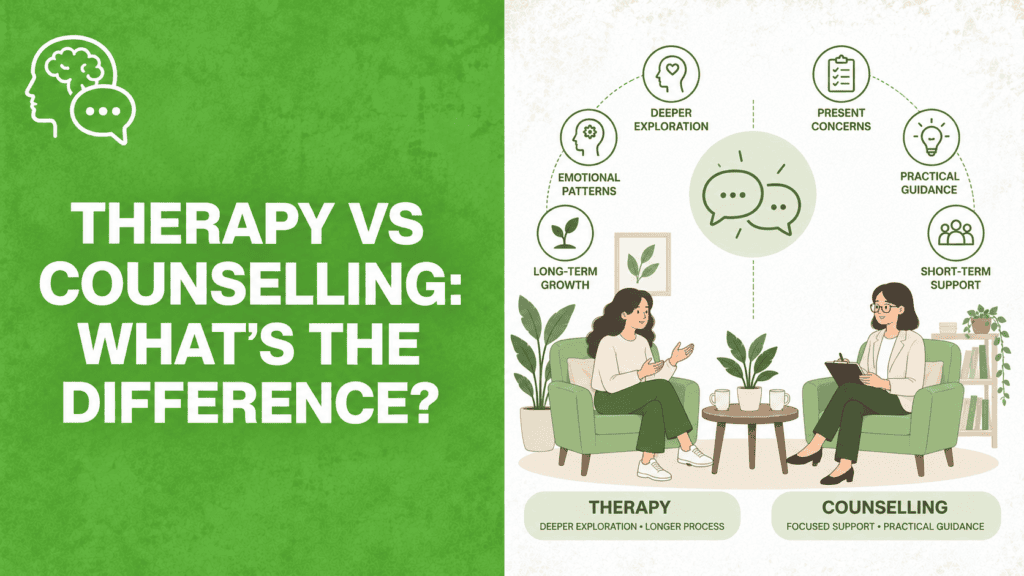
Counselling often focuses on specific, current-life concerns, while therapy may explore broader or deeper emotional and behavioural patterns over time.
For example:
If you are struggling to cope with stress after changing jobs, counselling may help you manage the immediate transition.
If work stress repeatedly triggers intense anxiety, perfectionism, fear of failure, and self-criticism across different jobs, therapy may explore the deeper patterns contributing to those reactions.
Neither approach is inherently better.
The right support depends on your concerns, goals, and individual circumstances.
Therapy vs Counselling: Key Differences
| Area | Counselling | Therapy |
|---|---|---|
| Primary focus | Specific current concerns or life situations | Emotional, behavioural, and psychological patterns |
| Typical goals | Coping, problem-solving, emotional support, adjustment | Understanding patterns, emotional processing, behavioural change, long-term growth |
| Duration | May be shorter-term | May be short-term or longer-term |
| Depth | Often centred on a specific situation | May explore deeper beliefs, experiences, and long-standing patterns |
| Examples | Grief, relationship conflict, career stress, life transitions | Anxiety, trauma, persistent low mood, recurring relationship patterns, emotional regulation |
It is important to remember that these distinctions are general rather than absolute.
A counselling process may become deeper and longer-term, while therapy may sometimes be brief and focused on a specific concern.
When Might Counselling Be Helpful?
Counselling may be useful when you are experiencing a specific challenge and want professional support to manage it more effectively.
Here are some common situations.
1. You Are Going Through a Major Life Change
Life transitions can create stress even when the change is positive.
Examples include:
- Marriage
- Parenthood
- Relocation
- Starting a new job
- Changing careers
- Retirement
- Separation or divorce
Counselling can help you process the transition, understand your emotions, and adapt to new responsibilities or expectations.
2. You Are Experiencing Relationship Difficulties
Counselling can support individuals or couples dealing with:
- Communication problems
- Recurring conflict
- Trust concerns
- Emotional distance
- Family disagreements
- Difficulty setting boundaries
The focus may be on understanding the current conflict and developing healthier ways of communicating.
3. You Are Coping with Grief or Loss
Loss can affect people in many different ways.
Counselling can provide a supportive space to process grief, adjust to change, and express emotions without judgement.
4. Work or Academic Stress Is Becoming Difficult to Manage
Deadlines, performance pressure, workplace conflict, exams, or uncertainty about the future can gradually become overwhelming.
Counselling can help you understand stressors, develop coping strategies, and establish healthier boundaries.
5. You Need Support Making an Important Decision
Some decisions can feel emotionally complicated.
Counselling provides a structured space to clarify priorities, explore options, and better understand what matters to you.
When Might Therapy Be Helpful?
Therapy may be useful when concerns are persistent, recurring, or linked to deeper emotional and behavioural patterns.
1. Anxiety Is Affecting Everyday Life
If worry, fear, overthinking, or avoidance is interfering with work, relationships, sleep, or daily functioning, therapy can help you understand what is maintaining the anxiety.
You may work on:
- Identifying triggers
- Recognising unhelpful thinking patterns
- Managing physical symptoms
- Reducing avoidance
- Developing healthier coping strategies
2. You Keep Repeating the Same Patterns
You may understand that a behaviour is unhelpful but still find yourself repeating it.
For example:
- Entering similar unhealthy relationships
- People-pleasing
- Avoiding conflict
- Seeking constant reassurance
- Procrastinating because of fear of failure
- Becoming defensive during difficult conversations
Therapy can help you explore where these patterns come from and develop alternative ways of responding.
3. You Are Struggling with Persistent Low Mood
If sadness, emotional numbness, low motivation, or loss of interest continues for an extended period, therapy may help you understand contributing factors and build healthier emotional and behavioural patterns.
4. Past Experiences Continue to Affect You
Some experiences continue to influence how we respond to situations long after they have happened.
Therapy may help people process difficult experiences and understand how past events influence current:
- Relationships
- Self-esteem
- Trust
- Emotional responses
- Fear and avoidance
5. You Want to Understand Yourself Better
Therapy is not only for managing distress.
Many people seek therapy because they want to better understand their personality, emotions, values, boundaries, relationships, and behavioural patterns.
This kind of self-awareness can support personal growth and healthier decision-making.
Is Therapy More Serious Than Counselling?
Not necessarily.
People sometimes assume that counselling is for “small problems” and therapy is only for serious mental health concerns.
This is an oversimplification.
Both counselling and therapy can support people experiencing meaningful emotional difficulties.
The difference is often related to the type of concern being addressed, the professional’s approach, and the goals of treatment rather than how “serious” the problem is.
Do Therapy and Counselling Use Different Techniques?
There can be significant overlap.
Both may involve:
- Talking through experiences
- Identifying emotional patterns
- Learning coping strategies
- Improving communication
- Developing self-awareness
- Exploring relationships
- Setting goals
Therapy may also use structured psychological approaches such as:
- Cognitive Behavioural Therapy (CBT)
- Dialectical Behaviour Therapy (DBT) principles
- Emotion-Focused Therapy
- Psychodynamic approaches
- Mindfulness-based approaches
- Trauma-informed interventions
- Solution-Focused Therapy
The approach used depends on the professional’s training, your concerns, and your treatment goals.
How Long Does Counselling Usually Last?
Counselling is sometimes shorter-term because it may focus on a specific concern.
Some people may benefit from a few sessions, while others may continue for several months.
The number of sessions depends on:
- The nature of the concern
- Your goals
- How long the concern has been present
- Your response to the counselling process
There is no fixed number that applies to everyone.
How Long Does Therapy Usually Last?
Therapy may be short-term or long-term.
Some structured therapies may focus on a specific concern over a limited number of sessions.
Other forms of therapy may continue for longer when the goal is to explore deeply established emotional or relationship patterns.
Your psychologist or therapist can discuss an appropriate treatment plan based on your needs and progress.
What Happens During the First Session?
Whether you attend counselling or therapy, the first session is generally an opportunity for the professional to understand what brings you there.
You may be asked about:
- Your current concerns
- How long you have been experiencing them
- How they affect your daily life
- Your relationships
- Work or academic stress
- Sleep and routine
- Past experiences that may be relevant
- Your current coping strategies
- Your goals for the sessions
You do not need to explain everything perfectly in your first appointment.
The process usually develops gradually as you become more comfortable and your therapist or counsellor understands your concerns more clearly.
How Do You Know Whether You Need Therapy or Counselling?
You do not need to make a perfect decision before seeking help.
A qualified mental health professional can help determine the type of support that may be most appropriate.
As a general guide:
- If you are dealing with a specific current problem and want support, coping strategies, or guidance, counselling may be helpful.
- If concerns are persistent, recurring, or connected with deeper emotional and behavioural patterns, therapy may be helpful.
- If you are unsure, starting with an initial consultation can help clarify what kind of support you need.
Therapy or Counselling for Anxiety?
Both may be helpful depending on the nature of the anxiety.
If anxiety is related to a specific stressful situation, counselling may help you manage the immediate concern.
If anxiety is persistent, recurring, involves significant avoidance, or is affecting multiple areas of life, structured therapy may be more appropriate.
Therapeutic approaches such as Cognitive Behavioural Therapy can help people understand and change patterns that maintain anxiety.
Therapy or Counselling for Relationships?
Relationship concerns can be addressed through both counselling and therapy.
Relationship counselling may focus on:
- Current communication difficulties
- Recurring arguments
- Decision-making
- Premarital concerns
- Managing a specific relationship transition
Relationship therapy may explore deeper patterns such as:
- Attachment patterns
- Emotional triggers
- Repeated conflict cycles
- Trust difficulties
- Long-standing emotional distance
In practice, the two terms are often used interchangeably in couples work.
Therapy or Counselling for Stress?
Counselling can be particularly helpful for situational stress related to work, relationships, family responsibilities, or major life changes.
Therapy may be useful when stress is linked to ongoing patterns such as perfectionism, difficulty setting boundaries, chronic worry, people-pleasing, or self-criticism.
Therapy or Counselling for Grief?
Counselling can provide valuable support during grief and bereavement.
It can offer a safe space to process emotions and adjust to life after a loss.
Therapy may be considered when grief is accompanied by persistent emotional difficulties, trauma-related symptoms, depression, or patterns that significantly affect daily functioning.
Can Therapy and Counselling Be Online?
Yes.
Many forms of counselling and psychological therapy can be provided online through secure video consultations.
Online sessions can be useful for people who:
- Live far from a clinic
- Have busy work schedules
- Travel frequently
- Prefer receiving support from home
- Have difficulty attending in-person appointments
Whether online or in person, the most important factor is working with a qualified professional whose approach matches your needs.
How Do You Choose the Right Mental Health Professional?
Whether you are looking for counselling or therapy, consider factors such as:
- The professional’s qualifications
- Clinical training
- Experience with your type of concern
- Therapeutic approach
- Whether sessions are online or in person
- How comfortable you feel speaking with them
The therapeutic relationship is important.
You should feel respected, heard, and able to discuss your concerns without fear of judgement.
When Might You Need a Psychiatrist Instead?
Counselling and psychological therapy primarily involve psychological interventions.
However, some situations may also require psychiatric assessment.
You may consider consulting a psychiatrist when:
- Symptoms are severe or significantly affecting daily functioning
- Medication may be required
- There are significant changes in mood or behaviour
- You are experiencing hallucinations or severe confusion
- Symptoms have not improved despite psychological support
Psychologists and psychiatrists may also work together when both therapy and medication management are appropriate.
When Should You Seek Immediate Mental Health Support?
Some concerns require urgent professional attention rather than waiting for a routine counselling or therapy appointment.
Seek immediate help if you or someone you know is experiencing:
- Thoughts of suicide or self-harm
- An immediate risk of harming themselves or another person
- Severe confusion or disorientation
- Hallucinations
- Significant loss of contact with reality
- Extreme behavioural changes
- Inability to care for basic needs
In these situations, contact an appropriate emergency service, hospital, psychiatrist, or qualified mental health professional for immediate assessment.
Frequently Asked Questions
Are therapy and counselling the same thing?
They are similar and the terms are often used interchangeably.
Generally, counselling may focus more on specific current concerns, while therapy may explore deeper emotional, behavioural, or relationship patterns.
However, the exact distinction varies depending on the professional and setting.
Is counselling shorter than therapy?
It can be, but not always.
Counselling may sometimes be shorter-term because it focuses on a specific concern. Therapy may continue longer when the goals involve deeper or long-standing patterns.
The duration of either depends on individual needs.
Which is better: therapy or counselling?
Neither is inherently better.
The most appropriate approach depends on your concerns, goals, symptoms, and the kind of support you are looking for.
Do I need a mental health diagnosis to attend therapy or counselling?
No.
You can seek support for stress, relationship difficulties, grief, major life changes, self-esteem concerns, decision-making, or personal growth without having a mental health diagnosis.
Can counselling help with anxiety?
Yes.
Counselling may help with anxiety related to a specific life situation or stressor.
For persistent or more complex anxiety patterns, structured psychological therapy may also be recommended.
Can therapy help even if I do not know what is wrong?
Yes.
You do not need to know exactly what is causing your distress before seeking support.
A psychologist or therapist can help you explore your experiences and understand what may be contributing to how you feel.
How do I know if the therapist or counsellor is right for me?
You should generally feel respected, listened to, and comfortable enough to discuss difficult experiences at your own pace.
It can take time to build trust, but the professional relationship should feel safe, collaborative, and non-judgemental.
Final Thoughts
Therapy and counselling share the same broad goal: helping people improve their emotional and psychological well-being.
The difference between them is often less important than finding the right kind of support for what you are experiencing.
Counselling may be particularly useful when you are navigating a specific challenge such as stress, grief, a relationship difficulty, or a major life transition.
Therapy may be helpful when concerns are persistent, recurring, or connected with deeper patterns in your emotions, thoughts, relationships, or behaviour.
But these categories often overlap.
You do not need to decide exactly what type of support you need before reaching out.
A qualified mental health professional can help you understand your concerns and recommend an appropriate approach.
At Inspiron Health, our experienced psychologists provide compassionate, evidence-based counselling and psychological therapy for anxiety, stress, overthinking, low mood, relationship difficulties, emotional concerns, and major life transitions.
Whether you are dealing with a specific challenge or want to better understand long-standing emotional patterns, our psychologists can help you identify the type of support that best fits your needs.
If you feel that something has been difficult to manage on your own, book a consultation with Inspiron Health and take the first step towards better emotional well-being.